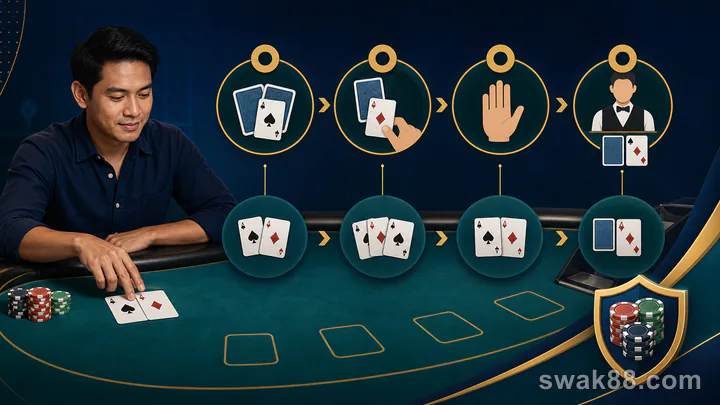
The Goal of Every Blackjack Hand
Before you click a single chip in a blackjack table game, fix the objective in your mind: finish the hand closer to 21 than the dealer without going over. You are not trying to hit 21 — you are trying to beat one opponent, the dealer, who must play by fixed rules. Once that clicks, every decision in the game becomes a comparison between your cards and the dealer's face-up card.
This guide walks through your first online hand step by step: card values, the deal, each decision you can make, and the small set of rules that keeps beginners out of trouble.
Step 1: Know the Card Values
| Card | Value |
|---|---|
| 2–10 | Face value |
| Jack, Queen, King | 10 |
| Ace | 1 or 11, whichever helps your hand |
A hand with an ace counted as 11 is called a soft hand (soft 17 = ace + 6), because you cannot bust by taking one more card — the ace simply drops to 1. A hand without that flexibility is hard.
Step 2: The Deal
After you place your bet, you receive two cards face up. The dealer receives one card face up (the "upcard") and, in most online formats, one face down. If your first two cards are an ace plus a ten-value card, that is a natural blackjack, and a fair table pays it at 3:2 — one and a half times your bet — rather than the 1:1 paid on ordinary wins. Before you sit down, open the table rules panel and confirm it says "Blackjack pays 3:2"; a 6:5 payout quietly takes a much larger cut of your best hands.
Step 3: Your Four Decisions
When the action reaches you, the game offers up to four buttons. Here is what each one does and when beginners should use it, based on basic strategy — the mathematically derived playbook for every combination of your hand and the dealer's upcard.
- Hit — take one more card. You can hit repeatedly until you stand or bust. Any hand of 11 or less is a free hit: no single card can bust you.
- Stand — keep your total and end your turn. Stand on hard 17 or higher, always. For totals of 12–16, the general rule is: stand when the dealer's upcard is weak (2–6), hit when it is strong (7–ace).
- Double down — double your bet and receive exactly one more card. It is the strongest weapon in the game when used on a total of 11, because so many cards make 21 or 20.
- Split — when your two cards are a pair, split them into two separate hands, each with its own bet. The two rules worth memorizing on day one: always split aces and 8s, never split 10s or 5s. A pair of 8s is a terrible 16 that becomes two decent hands; a pair of 10s is already a winning 20.
Some tables also offer insurance when the dealer shows an ace. It is a side bet that the dealer has blackjack, and basic strategy's answer is simple: decline it, every time.
Step 4: The Dealer Plays by Script
After all players finish, the dealer reveals the hole card and follows fixed house rules — typically drawing to 16 and standing on 17. The dealer makes no choices, which is exactly why your choices matter: played with basic strategy, blackjack's house edge falls to roughly 0.5%, among the lowest of any casino game. Played by feel, that advantage disappears fast.
A Practice Routine for Your First Sessions
You do not need to memorize a full strategy chart before your first hand — you need a routine that builds the habit of consulting one.
- Open a free-play or demo blackjack game so no money is at stake.
- Keep a basic strategy chart open beside the game window.
- Play 50 hands making every decision from the chart, not from instinct.
- Note every hand where the chart's answer surprised you — those are the decisions you would have gotten wrong for real money.
- Only move to real stakes once a full session produces no surprises, and start at the lowest table minimum you can find.
First-Hand Checklist
- The table rules panel confirms blackjack pays 3:2, not 6:5.
- I know my hand's total and whether it is soft or hard.
- I checked the dealer's upcard before choosing hit or stand.
- I will always split aces and 8s, and never split 10s or 5s.
- I will decline insurance every time it is offered.
- I set a session budget first, and I am playing with money I can afford to lose.
Play your first hands slowly — online blackjack tables let you take your time, and a deliberate decision from a chart beats a fast guess every single round.
Related Reading
For a closely related guide on this site, read Table Game Casino Guide 2026: How to Choose Your First Online Table Game in the Philippines.