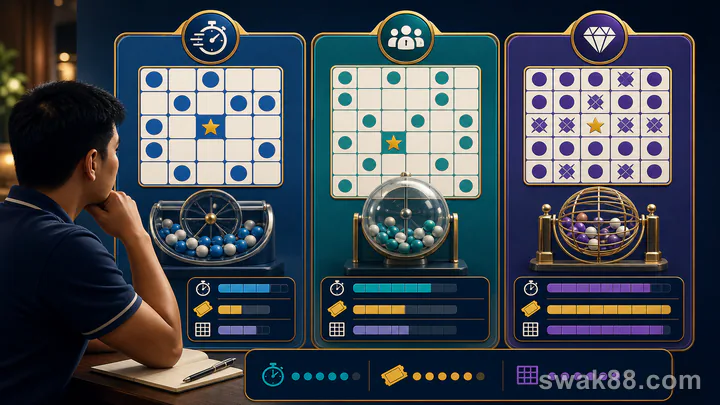
The ball count is the first thing that should decide which bingo room you join
If you're new to online bingo casino play, the format name — 90-ball, 80-ball, or 75-ball — tells you almost everything about how a round will feel before you buy a single card. Get that one choice right and the rest of the decision (which room, which card price, how many cards to run at once) gets a lot easier.
| Format | Balls drawn | Card layout | Typical round length | Best fit for |
|---|---|---|---|---|
| 90-ball | 1–90 | 9 columns × 3 rows, 15 numbers per card | 8–12 minutes | Players who want multiple win stages (line, two lines, full house) in one round |
| 80-ball | 1–80 | 4×4 grid, 16 numbers per card | 5–8 minutes | Players who want pattern variety (corners, letters, blackout) without a long round |
| 75-ball | 1–75 | 5×5 grid with a free center space | 6–10 minutes | Players who like pattern-based wins and are used to North American-style bingo |
90-ball: three chances to win in a single round
90-ball bingo pays out at three stages of the same round — one line, two lines, then a full house — so you're not waiting until the very last number to see any return. That structure makes it the format most players default to first, since a near-miss on the full house still often means a line or two-line win landed earlier in the same round. The tradeoff is round length: with three win stages built in, a 90-ball round typically runs longer than the other two formats, which matters if you're playing between other things and want a quick round rather than a 10-minute commitment.
80-ball: fastest pattern variety
80-ball uses a 4×4 grid instead of strips, and rooms built around it usually rotate through pattern calls — four corners, a letter shape, a full blackout — rather than sticking to one fixed win condition. That rotation is what makes 80-ball feel faster and more varied than 90-ball even though the numbers drawn (1–80) cover a smaller range: you're watching for a specific shape rather than counting down to a fixed line, so rounds tend to resolve in under eight minutes.
75-ball: the format most players already recognize
75-ball is the layout most players picture when they hear the word bingo — a 5×5 card with a free center space — and rooms running it lean on the same pattern-call structure as 80-ball (shapes and blackouts) rather than 90-ball's line-based stages. The free space effectively gives you a head start on every pattern, which is a small but real edge over formats without one, and it's part of why 75-ball rooms tend to run slightly shorter average rounds than 90-ball despite drawing from a similar-sized number pool.
What happens if you mix formats without realizing it
A common mistake for players moving between rooms is assuming every bingo casino room works like the last one they played, and that mismatch usually shows up at the worst moment — mid-round, when you thought you had a full house but the room was actually calling a pattern shape instead of a straight line. Before you buy into a room you haven't played before, check the format label and the win-condition description in the room rules rather than assuming from the card layout alone; a 4×4 grid could be running either an 80-ball pattern game or a house-specific variant with its own rules, and the two pay out very differently.
Multi-tabling — running cards in more than one room or format at the same time — is where format confusion gets expensive fastest. If you're going to run two rooms at once, keep them on the same format at first so you're not mentally switching between "count down to one line" (90-ball) and "watch for a shape" (80-ball or 75-ball) in the same sitting. Once you're comfortable telling the formats apart at a glance, mixing becomes less risky, but it's not where a new player should start.
How to actually pick a room once you know the format
Once you've settled on a format, three things separate a room worth joining from one that's just going to eat your bankroll faster than it needs to:
- Card price relative to prize pool. A room selling ₱20 cards into a ₱500 total prize isn't the same value as one selling the same ₱20 card into a ₱2,000 prize — check the payout structure before buying in, not after.
- Auto-daub availability. If you're running more than two or three cards at once, a room without automatic number-marking will have you missing calls constantly; manual daubing only makes sense with a single card.
- Chat and community pace. Bingo casino rooms live or die on how active the chat is between rounds — a quiet room with long gaps between draws usually means low player counts, which also means smaller prize pools even at the same card price.
Our table game selection guide covers the licensing and payment checks that apply to bingo rooms the same way they apply to any other table game, and it's worth running through before you deposit into a new room. If you want to see how one reviewed operator structures its bingo lobby in practice, Swak88 is one of the platforms in our directory that lists room schedules and card pricing up front rather than only after signup.
Format and room checklist
Before you buy into your first bingo casino round, confirm:
- You know whether the room runs 90-ball, 80-ball, or 75-ball, and picked the format that matches how much time you have.
- Card price is checked against the advertised prize pool, not just the ticket cost alone.
- Auto-daub is available if you plan to run more than two cards per round.
- The room shows an active chat or player count before you buy in.
- Licensing and payment details have been checked using the same criteria you'd apply to any other table game on this site.
Picking the right ball count first, then screening the room on price and activity, gets you to a round worth playing faster than scrolling through a "best bingo sites" list ever will.
Related Reading
For a closely related guide on this site, read Table Game Casino Plus Guide: Which Live Tables Fit New Filipino Players.