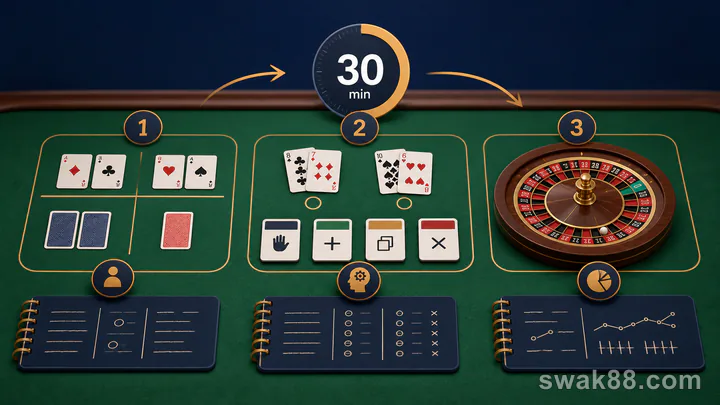
What this 30-minute drill teaches
The fastest way to learn table games casino online is not to read ten strategy pages and immediately deposit. Use one 30-minute demo session to practice the mechanics that transfer to a real table: placing one clear bet, predicting settlement, recording the result, and stopping after a fixed number of rounds.
Split the session into three ten-minute blocks: baccarat for fixed drawing rules, blackjack for player decisions, and European roulette for bet coverage. Demo credits are not money and demo results cannot be withdrawn. The point is to make every round understandable, not to prove a winning system.
Prepare the drill
Create a simple note with five columns: game, starting balance, stake, expected settlement, actual settlement. Disable autoplay and turbo modes. Use the same notional stake—such as ₱20—when the demo allows it. If it does not, record the displayed demo unit and do not pretend it equals pesos.
Set a timer for 30 minutes. Do not reset the virtual balance after a loss. A reset hides how quickly a game and stake combination consumes funds. The final balance is not a forecast; it only verifies that you tracked deductions and returns correctly.
Minutes 0–10: baccarat round flow
Start with Player and Banker bets only. Standard baccarat totals use the last digit: 7 plus 8 is 5. A natural 8 or 9 ends drawing. If there is no natural, Player draws on 0–5 and stands on 6–7. Banker then follows its fixed rule, using Player's third card when applicable.
Use this five-hand sequence:
- Bet Player and state that a Tie will push.
- Bet Banker and identify whether the table charges commission.
- Bet Player again and calculate totals before the result overlay appears.
- Bet Banker and observe whether a natural stops all drawing.
- Choose either main bet and explain the third-card outcome from the table rules.
Do not use the Tie bet for this drill. It pays more because it occurs less often and has a substantially higher house edge. Pair and bonus side bets also distract from the main hand flow.
Record the stake before dealing and the credited amount after settlement. If a Banker win credits less than a Player win at the same stake, confirm the commission calculation. If a no-commission table changes the payout on Banker 6, write that exception in the note.
Minutes 10–20: blackjack decisions
Before the first hand, record the table rules: number of decks, blackjack payout, dealer soft-17 rule, double options, and split rules. A 3:2 blackjack payout is better than 6:5. Use a basic-strategy chart that matches the configuration.
Play up to five hands. For each one, write the dealer upcard and your initial total. Then choose from hit, stand, double, or split before clicking.
Focus on these decision types when they appear:
- Hard total: no ace counted as 11.
- Soft total: an ace currently counts as 11 without busting.
- Pair: two same-rank cards may be split under table rules.
- Double opportunity: one additional card in exchange for doubling the initial stake.
Skip insurance. It is a separate wager that the dealer has blackjack, not a repair tool for the main hand. Skip side bets as well. They do not teach basic hand decisions.
If the demo does not naturally deal every situation, do not keep playing until it does. The drill tests decision recording, not card counting. Compare your selected moves with the complete first-hand blackjack walkthrough afterward and mark any mismatch.
Minutes 20–30: roulette coverage and payouts
Choose European roulette with one zero. Confirm that the wheel and betting board show numbers 1–36 plus 0. Do not use an American double-zero wheel for this drill because it changes the probability and house edge.
Play five spins with five different bet shapes:
- Red or black: covers 18 numbers and pays 1:1.
- Odd or even: covers 18 numbers and pays 1:1.
- One dozen: covers 12 numbers and pays 2:1.
- One column: covers 12 numbers and pays 2:1.
- One six-line bet: covers six adjacent numbers and commonly pays 5:1.
Before each spin, point to every covered number. Zero is not covered by ordinary red/black, odd/even, low/high, dozen, or column bets. After the result, calculate the return and confirm it against the balance.
Do not increase stakes after a loss. A progression changes total exposure but not the next wheel result. Keep one unit per spin so the five bet shapes remain comparable.
Score the session
Give one point for each statement you can answer without reopening the help screen:
- Baccarat totals drop the tens digit.
- A baccarat natural 8 or 9 stops drawing.
- Standard Player and Banker bets push on Tie.
- Blackjack decisions depend on both player total and dealer upcard.
- Insurance is separate from the main hand.
- European roulette has one zero.
- A dozen covers 12 numbers.
- The selected stake stayed constant through the drill.
Seven or eight points means the basic round flows are ready for a second demo session. Five or six means repeat only the weak block. Four or fewer means slow down and use one game per session.
Adapt the drill to a mobile phone
On an entry-level Android device, run the drill in portrait and landscape before choosing a mode. Confirm that the stake, total bet, and decision buttons never overlap. For live tables, test the stream on normal prepaid data and note whether the betting timer remains synchronized.
Switch between Wi-Fi and mobile data only between rounds. Wait for balance and history to update. If a stream freezes after a confirmed bet, do not submit the same wager again; inspect round history first.
When to move beyond demo mode
Demo practice is complete when you can describe the next action and settlement before the animation. It cannot show withdrawal behavior, real-money emotions, or whether a small stake feels affordable. If you later choose real play, use a budget that supports a fixed number of rounds at the table minimum and stop at that number.
The drill succeeds even if the demo balance falls. Learning table games casino online means understanding decisions, not manufacturing a winning sample. Keep the worksheet, repeat the weakest ten-minute block, and choose one table only after its rules and mobile controls are clear.
Repeat the full drill on a second day before changing any rule. If the first session used a slow home connection, repeat it on the prepaid data and phone you would normally use. Compare missed timers, accidental taps, and average rounds completed—not wins. Then choose the format with the fewest operational mistakes. A slightly slower game you can follow accurately is a better beginner table than a faster one whose buttons, totals, or settlement disappear before you can verify them.
The score applies only to the tested rules and device. A high score does not prove long-term stability or predict returns. Repeat the drill whenever a table changes its minimum, blackjack configuration, or mobile layout.
Keep the second worksheet beside the first. Improvement means fewer rule and input errors under the same drill, not a higher virtual ending balance. If accuracy falls on mobile data, choose the slower table or use RNG demo mode until the connection is stable.
Related Reading
For a closely related guide on this site, read Table Games Online Casino Odds: How House Edge Differs Across Blackjack, Baccarat, and Roulette.