The shortest useful explanation
A Texas Hold'em poker game is a contest to make the best five-card hand—or persuade every opponent to fold—using two private hole cards and five shared community cards. A hand moves through preflop, flop, turn, and river betting. You never have to use both hole cards, and you do not need to reach the showdown to win.
For a first practice table, focus on only four skills: recognize the action order, know the legal choices, build exactly five cards at showdown, and stop entering weak starting hands just because you have already posted a blind. Bluffing can wait.
What you need before the first deal
Texas Hold'em uses a standard 52-card deck and a dealer button that moves clockwise after each hand. The player left of the button posts the small blind; the next player posts the big blind. These forced bets create a pot before cards are dealt.
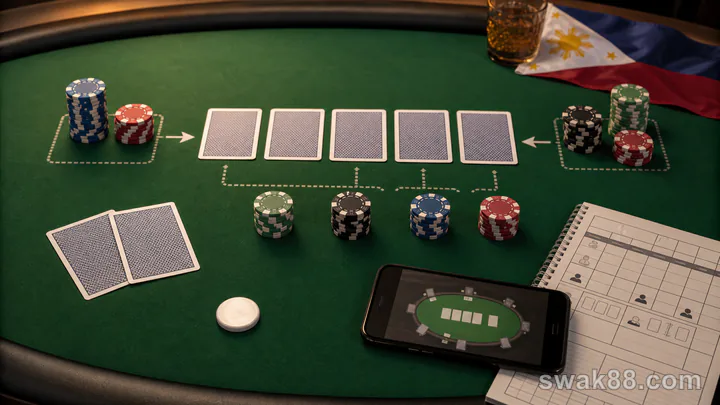
Each player receives two face-down hole cards. The table later reveals five community cards in three stages. Your final hand is the best five-card combination available from all seven cards. You may use two, one, or zero hole cards.
| Term | What it means | Beginner check |
|---|---|---|
| Button | Marks the nominal dealer position | Action generally starts left of it after the flop |
| Small blind | Smaller forced bet | Do not treat it as a reason to call any raise |
| Big blind | Larger forced bet | Sets the normal preflop call amount |
| Pot | Chips contested in the hand | Confirm the displayed total before sizing a bet |
| Board | Shared community cards | Build your best five-card hand from board plus hole cards |
| Showdown | Remaining hands are compared | Cards speak; the strongest valid five-card hand wins |
Hand rankings from strongest to weakest
Memorize the order before learning strategy:
- Royal flush: ace-high straight flush.
- Straight flush: five consecutive cards of one suit.
- Four of a kind: four cards of the same rank.
- Full house: three of one rank plus two of another.
- Flush: five cards of one suit, not consecutive.
- Straight: five consecutive ranks in mixed suits.
- Three of a kind: three cards of one rank.
- Two pair: two different pairs.
- One pair: two cards of one rank.
- High card: none of the combinations above.
An ace can be high in A-K-Q-J-10 or low in A-2-3-4-5, but it cannot wrap around in Q-K-A-2-3. Suits do not outrank one another in standard Hold'em.
Round 1: preflop
After hole cards are dealt, action begins with the player left of the big blind. That player can fold, call the big blind, or raise. Action continues clockwise until every remaining player has matched the current wager or folded.
Beginners often call too widely because seeing the flop feels inexpensive. Use a deliberately small opening range in practice:
- Play high pairs and strong high-card combinations from any position.
- Add medium pairs and suited connected cards mainly from later position.
- Fold disconnected low cards, especially when they are offsuit.
- Treat an early-position raise as stronger than a late-position open until you have evidence otherwise.
Position matters because later players see more actions before deciding. On a nine-seat table, A-J offsuit may be a reasonable late-position open but a cautious fold against an early raise and re-raise.
Round 2: the flop
The dealer reveals three community cards. Action starts with the first active player left of the button. If nobody has bet, you may check and pass action without folding. Once a bet is made, the choices are call, raise, or fold.
Classify your hand before touching a button:
- Made hand: a pair or better that may already lead.
- Strong draw: for example, four cards to a flush or an open-ended straight draw.
- Weak draw: a gutshot straight draw or overcards without additional support.
- Air: little current value and few improving cards.
Then compare the board texture. K-7-2 with three different suits has few immediate draws. J-10-9 with two hearts connects with many straights, pairs, and flush draws. A one-pair hand should not be treated the same way on both boards.
Round 3: the turn
The turn adds one community card and triggers another betting round. With only one card still to come, drawing hands have less time to improve. Bet sizes also tend to be larger because the pot has grown.
Before calling a turn bet, ask three concrete questions:
- Which river cards improve my hand?
- Could an apparent “out” also make an opponent a stronger hand?
- Is the call small enough relative to the pot to justify trying?
Example: you hold A♥ 8♥ on K♥ 7♥ 2♣ 4♠. Nine unseen hearts can complete a flush, although you cannot assume every heart wins against every possible hand. A large turn bet requires a more demanding price than a small one.
Round 4: the river
The river is the fifth and final community card. No more cards will arrive, so every decision is about current hand strength, value, and bluffing—not future improvement.
If checked to with a strong hand, consider what worse hands can call a bet. If facing a bet with a medium hand, identify the missed draws an opponent could bluff and the completed hands that beat you. “I have already invested a lot” is not a valid reason to call; chips placed on earlier streets are no longer yours.
When betting ends, the remaining players show cards. Build the strongest five-card hand, not a six- or seven-card combination. If the board itself is A-K-Q-J-10 with no possible higher hand, all remaining players split the pot regardless of their hole cards.
Betting choices in plain English
| Action | When it is available | What it does |
|---|---|---|
| Check | No bet faces you | Passes action while keeping the hand alive |
| Bet | No bet faces you | Places the first wager on that street |
| Call | A bet faces you | Matches the current wager |
| Raise | A bet faces you | Increases the wager opponents must match |
| Fold | Any wager faces you | Gives up the hand and all claim to the pot |
| All-in | You wager your remaining stack | Caps your personal risk at the chips in front of you |
A common interface mistake is confusing “check” with “check/fold.” Read the button state before the action timer expires, especially on a small phone screen.
Pick a first table that works on a Philippine mobile setup
For a player using a budget Android phone and prepaid data, table selection changes the quality of practice. Start with one standard six- or nine-seat play-money Hold'em table, one table only, and the slowest normal action timer available. Avoid multi-table mode, fast-fold pools, and animated side games until the action order is automatic. Large buttons, a readable pot size, and a visible hand-history button matter more than decorative avatars.
Observe the connection for one orbit before joining. Switch between Wi-Fi and mobile data only after folding or after a hand has settled; changing networks while facing a bet can let the timer choose a default fold. If controls stop responding, do not tap call or raise repeatedly. Reconnect, open the hand history, and confirm whether the server recorded an action.
For active practice opponents, early evening in Philippine Time often fits local after-work play, while late-night international tables may be busier but faster and less beginner-friendly. Table traffic varies, so use the live seat count rather than assuming a fixed hour. Choose a low-blind or play-money table where one buy-in covers at least 50 big blinds; a very short stack removes many turn and river decisions that this exercise is meant to teach.
A 30-minute first practice table
Use play-money or a no-stakes training table until the sequence feels automatic.
- Minutes 0–5: identify the button, blinds, action order, and current pot every hand.
- Minutes 5–10: play only pairs, A-K through A-J, and K-Q; fold everything else.
- Minutes 10–15: name the flop texture—dry, connected, paired, or two-tone—before acting.
- Minutes 15–20: count plausible improving cards for draws without assuming they are guaranteed winners.
- Minutes 20–25: at every showdown, state the exact five-card hand.
- Minutes 25–30: review three folded hands and three played hands; note whether position changed the decision.
This narrow exercise teaches the flow faster than playing every deal. It also separates real poker from casino poker variants where the player competes against the house rather than other players. For a broader view of table formats, see the table game selection guide.
Cash games, tournaments, and casino poker variants
In a cash game, chips represent money and blinds usually stay fixed for the session. You can normally leave between hands. In a tournament, chips are tournament units, blinds rise, and losing all chips ends your entry. A small entry fee can still create a long commitment.
Caribbean Stud, Casino Hold'em, and Ultimate Texas Hold'em may use familiar cards, but their betting structure and opponent are different. Do not carry a Texas Hold'em starting-hand chart into those games without learning their paytables and rules.
If you prefer live streamed tables, review how limits, pace, and connection quality change the experience in this online live casino checklist.
Five mistakes to remove first
- Playing too many starting hands because folding feels boring.
- Calling a raise without checking position and stack size.
- Counting any pair as strong on a coordinated board.
- Chasing a draw without comparing the call with the pot.
- Showing results-based thinking: a poor call remains poor even when the river happens to help.
Ready-table checklist
You are ready for a low-pressure first table when you can follow all four betting streets, rank hands without guessing, explain check/bet/call/raise/fold, and build the final five-card hand correctly. Start at one table, turn off distracting animations if possible, and keep the session short enough to review decisions afterward.
That foundation will improve a beginner's poker game far more than memorizing dramatic bluffs.
Related Reading
For a closely related guide on this site, read Table Game Casino Guide 2026: How to Choose Your First Online Table Game in the Philippines.